
The Tehran Snapshot
Climate retreat and the geopolitics of the future

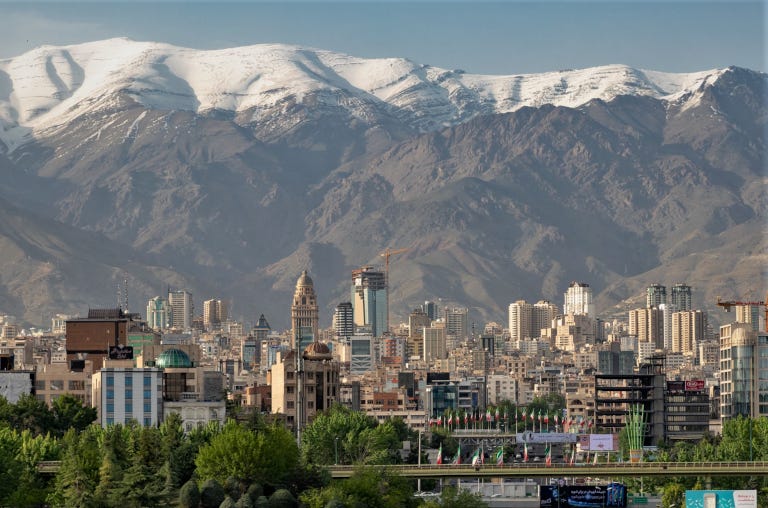
Iran is in the grips of a historic drought, which has been dragging on for 5 long years. The situation has got so severe that the Iranian government is openly contemplating evacuating their capital city, with the president announcing, “If it doesn’t rain again, we will have to evacuate Tehran”.
Would this evacuation be temporary? permanent? The answer is still a maybe.
It’s not easy to predict what the outcome will be, but the fact that the question is being debated at all is a stark sign that we’re in a new climate era, with a new set of policies and geopolitical strategies emerging — fitfully — in reaction.
Tehran, Running Dry
This is undeniably a climate story. Rain patterns have been essentially erased by worsening climate conditions, and the elevational creep of temperature gradients has left the beautiful, snowy peaks surrounding Tehran bare — but there is much more to it than just changing weather.
It’s difficult to state how extreme this crisis (and the political reaction) is. Tehran is home to nearly 10 million people — a city almost the size of London — about to (potentially) be driven out by thirst. When the government realised the city’s main reservoir was getting perilously low, they tried to reconnect to another one many miles away — only to find it was already dry. The city is also sinking nearly 1ft a year because so much groundwater is extracted, causing instability in homes and infrastructure. Dry soil has kicked up so much dust that, combined with exhaust emissions, Tehran is also in the throes of a major air pollution crisis, which has already killed hundreds.
There have been water restrictions imposed on the population, but these don’t change the fact that, if there’s no new water coming in, you’re just running out more slowly. And that’s if these measures were even working, or if personal water consumption was anywhere near the main issue.
Climate’s brought the crisis to a head, but there are much more fundamental issues at play. Water is being unsustainably used, mainly by state-backed agricultural projects driven by a combination of autarkic strategy and cronyism. There’s also the poor maintenance of infrastructure, meaning leaky pipes and water siphoning at every step of the journey. A corrupt, lethargic state with a million competing priorities (and many which are more immediately profitable to the ruling class) is letting its basic infrastructure rot away, a tale as old as time.
But to pretend it’s just a matter of poor engineering and a bit of graft is way off the mark. Yeah, it’s a country that has been accelerating towards its hydrological limits, but those limits are accelerating backwards almost as fast.
“Invoking climate change as the main explanation is politically convenient because it dilutes accountability”, a recent Forbes piece claimed. Maybe it does dilute accountability, but that’s kind of beside the point, because the crisis wouldn’t have been happening (now, at least) otherwise. And in climate, timing is everything.
It’s also a regional problem. Kabul is on the path to its own day zero. Iraq is wilting under drought and dust storms. Turkmenistan, Kazakhstan, Pakistan, Azerbaijan, and Turkey; they’re all in the grips of drought. Could all these places just be neglecting their hydrological resources? They likely are. But it doesn’t mean climate isn’t a key issue, just that their mismanagement has brought the moment of reckoning sooner.
Looking South
So where does the Iranian government intend to go? Assuming the relocation is permanent, the most likely of the potential new capitals is in Makran, a region on the nation’s southern coast. It’s an odd choice on the face of it — fleeing a drought-ravaged capital to an actual desert with only saltwater in any large quantity¹ — but Makran has its appeals. Its coastal position helps trade prospects; with most of the country’s manufacturing situated in the capital, industry has to import raw materials via the coast and laboriously haul them up into the mountains, before redoing the journey for export. This adds time, money, and friction. And you could always make the case that seawater can just be desalinated. Though that’s pretty expensive, Makran has amazing solar potential, and it’s certainly a lot cheaper than what they are doing now: desalinating at the coast and pumping it hundreds of miles up the mountains to reach the capital.
There are also potential political benefits to a Makran location. Moving capitals — even building a new one — has been a longstanding tradition for regimes looking to get away from entrenched interests or an uncooperative population. Think of Samarra, the Abbasid caliphs’ attempt to escape traditional power centres in Baghdad and house their deeply unpopular Turkic armies. And then there are modern examples of moving capitals, almost all of which have been to make a militarily secure ghost-town free from the restive masses of a teeming metropolis. The most on-the-nose example being Naypyidaw, the haunt of Myanmar’s military Junta — replete with 16-lane highways for tanks to more easily cruise along.
Iran isn’t the first nation to contemplate moving its capital to avoid climate change either. Indonesia has been in the process for the better part of a decade, shifting from Jakarta and its threat of sea level rise to the (still under construction) city of Nusantara, in the country’s interior. But Iran’s the first to consider it under immediate duress, as an emergency response. Even selecting a long-discussed potential successor, Makran, doesn’t imply this is a particularly well-thought-out plan. In fact, I’d argue that because Makran has been on the table for a few decades and they haven’t done it implies there are some extreme drawbacks to the plan.
So, what’s next? Do they evacuate just the government apparatus? Or some of the population? All of it? Do they do as Indonesia did, and shift the ‘political capital’ whilst keeping the ‘national capital’ in place? There isn’t much evidence to suggest one way or another, and there’s always a chance these announcements are just threats to cow water users into reducing consumption.
My bet is that it’ll rain in the near future, giving a temporary reprieve and canning (immediate) plans to move the capital — but it won’t refill reservoirs, drought will return, (ineffective) water restrictions remain, and they’ll resort to increasingly inefficient means of watering the city (like piping desalinated seawater hundreds of miles) that just kick the can down an increasingly rocky road. They’ll continue to blame the US for ‘stealing their clouds’ with cloud seeding and promise technological boondoggles like (ironically) cloud seeding. Water will become another intransigent issue feeding into the economic, political, military, and social turbulence wracking the Islamic Republic. Maybe they’ll even eventually move the capital, but I doubt they’ll do it in time to avoid the worst of the blowback (if there ever was such a time).
But the larger point remains: this is a good snapshot of the policy debates of the future. Abandonment, managed retreat, and (wildly disproportionate) reactive policies are coming down the pipeline. For many nations around the world, decisions like this are only a matter of time.
Abandonment as Policy
Managed (and not so managed) retreats are a pretty far-out policy response — especially when it comes to capitals. But so was geoengineering, which is now in its ‘Cambrian explosion’ era of public policy debates. I know you should never make predictions, but I’m willing to bet retreat and abandonment will absolutely become common policy debates. Even if they never (successfully) lead anywhere.
And the reason is thus: it’s more palatable to implement wildly reactive policies than to embark on major social transformations that don’t explode into revolt, either popular or reactionary. In the case of Iran, the social change necessary to tackle this issue could involve a major clampdown on regime-tied agri-business, a crackdown on corruption and inefficiency, a new trade policy to allow for greater food import dependency, and some form of redistribution of the spoils to prevent a repeat of consolidation in the wrong hands. And this is before they even start serious climate resilience measures, which, alongside more popular policies, would inevitably include deeply unpopular restrictions on water usage anyway.
As wild as swapping out capitals is, to a ruling class (who have a hand in all aforementioned problems, as well as genuine policy reasons for pursuing them, i.e., a food system not at risk of blockade), this seems more plausible than systemic change. I should clarify here, I hate the term systemic change, it’s an amorphously lefty, managerial class-coded phrase that obscures what it would actually entail: purging oligarchic elements that threaten the body politik and undermine the state’s right to rule. Whether the spoils are recouped by a more domineering state or redistributed to ‘the people’, it’s the only direct response like this that doesn’t resort to crazy decisions like, say, evacuating your capital city roughly 1,000 miles south.
But I don’t think that’s going to happen. At least not often. Maybe 2025’s ‘Gen-Z’ protests are an expression of this nascent impulse — In Nepal, climate adaptation was on the list of demands alongside an end to corruption. But, again, I doubt it. Retreat, abandonment, securitisation, geoengineering, and other colossal reactive policies which avoid the social changes needed for mitigation and true resilience are on the rise. The Tehran ‘evacuation’ is just an early, bumbling example of a world to come.
But here I think we really come to the crux of the issue. Because the evacuation might actually not be such a bad idea. Yes, a particular set of theocratic-military-oligarchic social relations sparked this crisis, sure, but it’s kind of just bad people making a bad situation worse. Tehran is a large, poorly planned city in a place that may simply not rain enough anymore.
Does the city justify the capital intensity of its maintenance? Will the cost curve start to outpace the political, economic, and social capital the state receives from situating itself there? It’ll be a much more chaotic process than if the Ayatollah and Prime Minister sat in a room with graphs and PowerPoint slides, but it’s not impossible that Tehran — and many other capital cities — will be pushed beyond viability by climate change. Almost all capital cities are situated for climatic as much as political and trade reasons, so if one of these major pillars of habitability gets knocked out, isn’t it quite reasonable to question the fundamental desirability of the political, economic, and cultural locus of your entire nation? The answer will increasingly be yes.
Climate abandonment can be avoided, or put off, in only so many cases. The culprits of this crisis may be water barons, but it is just one early punctuation point on a much longer, much steeper trendline.
-Ben Shread-Hewitt
Geo engineering does not have to be instead of the social changes needed for mitigation and true resilience but must be in addition to.
What I call the Climate Quad - reduce, remove, directly cool the climate and resiliently adapt.
Climate policy must accelerate all four of these pillars.
Really thoughtful and well done. Thank you
I do have a concern with how you seem to characterize Geo engineering
geoengineering, and other colossal reactive policies which avoid the social changes needed for mitigation and true resilience are on the rise.